
If you are looking for a First Aid Level 1, Level 2 or Level 3 course, you may have noticed that training providers now use different names. The three levels have been replaced by three QCTO skills programmes: Basic, Intermediate and Advanced Emergency First Aid Responder. They follow the same order as the old levels, so First Aid Level 1 is now Basic, Level 2 is Intermediate and Level 3 is Advanced.
This guide explains what changed, how the new courses compare, and what it means for your team and your existing certificates.
Old first aid levels and the new course names
| Old name | New QCTO course | NQF level | Credits | Typical duration | Ralmed price per learner |
|---|---|---|---|---|---|
| First Aid Level 1 | Basic Emergency First Aid Responder (SP-230801) | 2 | 2 | 2 to 3 days | R945 |
| First Aid Level 2 | Intermediate Emergency First Aid Responder (SP-230802) | 3 | 5 | 3 to 4 days | R1 450 |
| First Aid Level 3 | Advanced Emergency First Aid Responder (SP-230803) | 4 | 6 | 4 to 5 days | R1 750 |
Prices exclude VAT and include certification and course materials. The same price applies whether we train at your premises or in our Sandton training room, although travel costs may apply in some areas.
What actually changed?
The biggest change is how the courses are registered. Each one is now a skills programme registered with the Quality Council for Trades and Occupations (QCTO), with its own code, NQF level and number of credits. That makes it easier for employers and learners to see exactly what a course covers and how it fits with other qualifications.
The order and purpose of the courses have not changed. Each one still builds on the one before it:
- Basic (formerly First Aid Level 1) covers the essentials: scene safety, CPR for adults, children and infants, using a defibrillator (AED), choking, bleeding, burns, shock and fractures.
- Intermediate (formerly First Aid Level 2) adds more detailed casualty assessment, head, spinal, chest and abdominal injuries, tourniquets, diabetic emergencies, anaphylaxis and seizures.
- Advanced (formerly First Aid Level 3) prepares someone to lead the response: triage of several casualties, oxygen therapy, bag-valve-mask ventilation, vital signs and emergency response planning.
You can see the full content of each course, and compare two side by side, on our first aid courses page.
Which course does my workplace need?
Under Regulation 3 of the General Safety Regulations, a workplace with more than ten employees must have a person with a valid first aid certificate readily available during normal working hours, for every group of up to 50 employees (or up to 100 in shops and offices). Our Regulation 3 guide explains the rule and the first aid box it requires.
- Most workplace first aiders start with Basic (formerly First Aid Level 1).
- Higher-risk workplaces, such as sites with heavy machinery, chemicals or remote locations, usually need some staff at Intermediate (formerly First Aid Level 2).
- Safety officers and senior first aiders who take charge of incidents usually need Advanced (formerly First Aid Level 3).
Your risk assessment decides the final mix. If you are unsure, tell us what your team does and where they work, and we will recommend the right level.
What about existing Level 1, 2 and 3 certificates?
A first aid certificate stays valid for the period stated on it, which is usually three years. When it is due, your first aiders can do a refresher course instead of the full course, as long as two conditions are met:
- The current certificate must still be valid. Once it has expired, the full course is needed again.
- The refresher must be at the same level as the certificate. For example, a First Aid Level 1 certificate is refreshed on the Basic course.
A refresher takes about half the time of the full course, so it is worth keeping a record of when each certificate expires and booking before that date.
How Ralmed runs first aid courses
Ralmed is accredited by the HWSETA (accreditation no. HW592PAA000200), the QCTO and the Department of Employment and Labour (first aid training provider no. CI-179/3/12/1). Our courses are taught by people who work in emergency care, because Ralmed also runs a 24-hour ambulance service.
- Training at your premises anywhere in South Africa, or in our Sandton training room
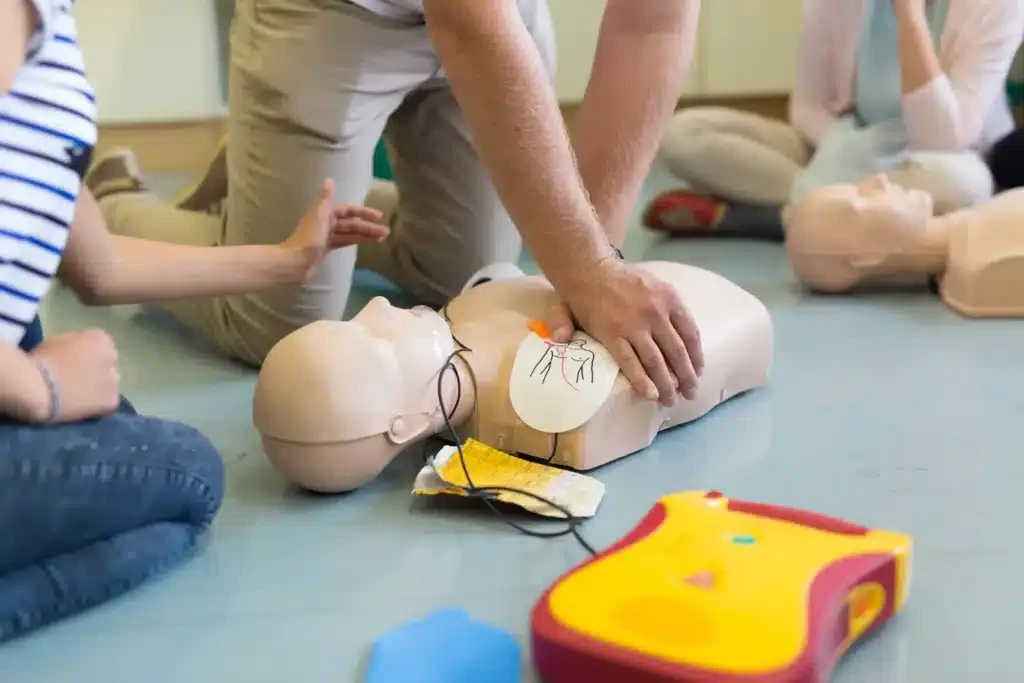
- Hands-on practice on mannequins and in realistic scenarios, with a practical assessment
- Group discounts for companies training several learners
- Individual bookings welcome
Frequently asked questions
Is First Aid Level 1 the same as Basic first aid?
Yes. Basic Emergency First Aid Responder (SP-230801) replaces First Aid Level 1. It is the starting point for workplace first aiders and needs no previous first aid training.
Is First Aid Level 3 still available?
The course is now called Advanced Emergency First Aid Responder (SP-230803). It replaces First Aid Level 3 and is the most advanced of the three workplace first aid courses.
Do I need Level 1 before I can do Level 2?
Usually, yes. Intermediate builds on Basic, and Advanced builds on Intermediate, so learners normally complete the course below first or show equivalent prior learning (RPL).
How long does a first aid course take?
Typically 2 to 3 days for Basic, 3 to 4 days for Intermediate and 4 to 5 days for Advanced. A refresher takes about half as long as the full course.
How much does a first aid course cost at Ralmed?
R945 per learner for Basic, R1 450 for Intermediate and R1 750 for Advanced, excluding VAT. Certification and course materials are included, and group discounts are available for companies.
Book a first aid course
For dates and a quote, call 0861 725 633, send a WhatsApp to +27 10 226 9725, email info@ralmed.com, or use the quote form on our first aid courses page. See also our first aid course price list.